01
ASMI Assist
One agent on the phone your office already carries, and a dashboard that reads the same record. No app to install, no training day.
An agentic AI company · Hyderabad, India
ASMI runs an intelligence desk for political leaders and party organisations in India. It reads the news and the public conversation around the clock, judges it under your doctrine, and puts the move on your phone — and now makes and answers calls for you, in nine languages.
Before 7 AM
the day’s threats, judged, on your phone
Before it sets
a forwarded claim, answered with the proof under it
Nothing
what this system has ever posted publicly. It drafts; you publish.
What we offer
01
One agent on the phone your office already carries, and a dashboard that reads the same record. No app to install, no training day.
02
Make and answer calls in nine languages, in a natural AI voice or your own consented voice. Disclosed as AI on every call.
03
Policy research and governance advisory for ministries, state governments and public institutions: evidence, field insight, programme design, implementation support and evaluation.
How the desk and the phone work together
An alert or a finding lands in your workspace.
One tap turns it into a call campaign, in the language of whoever picks up.
Every outcome comes back to the workspace: who answered, what they said, who to call back.
The deliverables
01
Forward the claim — a screenshot, a clip, a voice note in Telugu. Back comes a verdict, a two-line counter you can say on camera, and the proof underneath it.
02
Before your first meeting: what moved overnight, what it means for your seat, and the one thing worth doing about it today. Every line carries how well it is sourced, so you know which ones you can say out loud.
03
Some things cannot wait for tomorrow. When a story turns against you between briefs, the desk interrupts — what happened, why it matters to you, and the move. Not a notification. A decision.
04
A poster for the occasion, in your colours, with your leader’s photo — changed by telling it what to change. Every card we generate carries a visible AI-assisted label and its date.
05
Send it the budget PDF at midnight. Get back what is actually in it, every rupee figure ranked, the speaking points, and a workbook your team can work from.
06
A full three-month plan, and the official record behind any seat or ward — winner, runner-up, margin, and where your party actually stood.
Know what is being said. Know what it means. Know what to do.
A desk is not a feature, it is a discipline: read everything, decide what matters, draft the response, get it to the principal before the day starts — and remember what you led with yesterday. ASMI does that on a schedule, without being asked, and it does not have an off day.

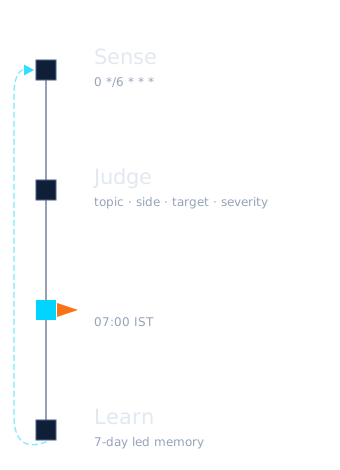
The news and the public conversation, on a fixed schedule. Old virals and other people’s states are filtered out before anyone reads a word.
Who attacked whom, on what, how loud. Filed the same way every day, so a trend is a count and not a feeling — then a frontier model decides what actually deserves your attention.
Brief, warning, rebuttal, card, plan. To your phone. Never to the public.
What it led with is remembered for a week, so you never get yesterday’s story twice. What landed and what was ignored shapes tomorrow’s.
Autonomous in the reading and the judging. Human in every publishing decision.
Why you can move this fast
Aggression is only an asset if it cannot blow up in your face. The limits that make this safe to use at speed are not instructions we hope a model remembers. They are conditions in the program — and the program does not have a bad night.
It will never advise you to defend a rival, and it cannot build you a counter to an attack that was never aimed at you — because the code will not assemble one.
Every publishable line is checked for communal and caste appeals and for unsubstantiated allegations — in Telugu, Hindi and Urdu as well as English. If the check cannot complete, the line does not go out.
Source tags on the brief, official-versus-modelled chips on the numbers. A missing source is a missing line, never an invented one.
Nothing inside ASMI can post anywhere. It drafts; you publish.
Consent gates every message, you can erase yourself in one command, and nothing you send is ever used to serve another client.
We will not run intelligence for two rivals in the same race — and the exclusivity your engagement carries is written into the contract, not just onto this page.
Starts from the official record, not an estimate
Most political software starts with an estimate and dresses it up. ASMI starts with the record, candidate by candidate: all 119 Telangana Assembly seats from 2023, and the 2025 Jubilee Hills by-election that superseded one of them REAL · ECI; the five Lok Sabha seats of the metro from 2024; the 2020 result, with votes and margins, for all 150 municipal wards; and the 300 gazetted wards of the new delimitation, with the 2,600 localities the gazette names inside them.
Beneath the results sit a district-by-district profile of the state, the daily print record of its newspapers, and every fact the desk has ever cited — each with its source. Every number is tagged official or modelled. Where a party is missing, it says unknown — never zero.
What it has read, as of October 2026
The results are the foundation. On top of them the desk keeps everything it reads, files it the same way every time, and remembers it. These are the counts in the system today, rounded down.
8,700+
newspaper stories from eight Hyderabad and Telangana publications, read daily since March 2025
62,000+
social posts observed from 224 accounts since June 2026, each one logged with its engagement
6,800+
incidents classified by who attacked whom, on what, and how seriously
7,300+
news stories the desk has retrieved and remembers, so it never leads with yesterday’s twice
3,300+
facts about seats, wards and districts, every one with its citation; all 33 Telangana districts profiled
390+
narrative threads: separate stories the desk recognised as one campaign
Competitive analysis
The war map sets every party’s attacks, openings and pushes side by side, with share of voice and momentum for each. Voices ranks each tracked account against its peers. Any two seats or parties can be compared head to head on the official results, and the movement from 2023 to 2024 is shown party by party, labelled as modelled.
Machine learning today
A fast language model files every post by topic, side, target and severity, and anything that would interrupt a leader is re-judged by a frontier model first. Stories are turned into embeddings, so the desk can tell when separate posts are one narrative and retrieve facts by meaning, not keywords. Every brief, alert and answer is logged with how it was received, over 3,000 so far, and that record shapes what the desk leads with next.
The roadmap, in the order we are building it. None of it changes the rules above: models propose, code and people decide.
Classifiers tuned on the desk’s own labelled incidents, in Telugu, Hindi, Urdu and the code-mixed speech people actually post in. Faster and cheaper on the everyday read, with the frontier model kept for the hard cases.
Velocity models that notice a story gathering pace across accounts and outlets hours before it peaks, and flag inauthentic amplification patterns, so the counter is ready while the story is still small.
A ranking model trained on what each office acted on and what it ignored, so the order of the morning read fits the person reading it — the principal, the spokesperson, the ward lead.
Vision and speech models that read posters, memes, video frames and voice notes in Telugu and Hindi as easily as text, and turn every ASMI Voice call into intent, sentiment and the question that was really asked.
Small-area models built on booth-level official results and public census tables, giving a ward-level picture where the official record stops at the constituency — always shown as modelled, never as fact.
Every leader, party, place, scheme and issue linked across years of results, print and social, so a question about one seat brings back its history, its people and what was said about them.
Every model scored against a held-out test set in each language before it reaches a client, with a person reviewing what it gets wrong. Client data trains nothing that serves another client, and no model profiles a voter.
Sharpened where it is hardest
ASMI has run daily for a state-level party organisation in a three-cornered southern state since 2026. Not a pilot deck: a brief every morning, alerts through the day, and a war map its operators open before they open anything else.
References are available in the room, not on the internet.
The party’s flagship action ran in three newspapers and, on social, almost nobody outside its own accounts carried it. The desk said so, at 7 AM, with the amplification move attached.
Engagements
One office. A dozen seats — the principal’s desk, the people who face cameras, and one operator seat that owns the alerts and the war map. You nominate the operator. We sit beside them for the first two weeks, then it is theirs: our access logged, and revocable by you in a sentence.
Three numbers agreed on day one — time from an opponent’s post to your cited counter; the share of your own pushes carried by accounts outside your own within a day; Model Code incidents, target zero.
Scoped pricing, one number for the office. Onboarding takes about a day once scope is agreed.
Ashayam Group · Hyderabad
The conversation that decides elections now moves faster than any room of people can read it. The answer is not a bigger room. It is a desk that never stops reading, judges what it finds against your doctrine rather than its own instincts, and shows its working every time it speaks. We built that in the hardest arena we could find, and we built the rules into the program — so it can be handed to someone at seven in the morning and trusted at five past.
Tell us who you are and the arena you’re in. We reply within one working day and scope a pilot.